What Kind of Art Is Four Horsemen of the Apocalypse
The Medieval period was a time when flesh passed through various determinative, and rather difficult stages marked past abiding warfare, dearth, Black Decease, and the rule of the Church. Information technology was a time saturated past superstition, peradventure all-time imagined and illustrated in the movies such every bit The Seventh Seal by Ingmar Bergman, and The Devils by Ken Russell.
As the cities were gradually forming, and especially the new form of feuds and wealthy merchants, the need for lavish objects and art in general increased. Throughout that time, monasteries had the leading educational role, while adept craftsmen started emerging in the Belatedly Heart Ages, in particular associations of artisans chosen the gilds.
An array of leading masters Renaissance were nurtured in these specific formations, while the artistic development of some was an result of the family trade. Such was the instance with the celebrated High german painter, theorist and a pioneering printmaker, Albrecht Dürer (1471 - 1528). This Nuremberg-born figure chop-chop gained an international reputation, especially for his remarkable woodcut prints. Dürer networked well with other prominent figures at the fourth dimension such every bit Italian artists Raphael, Giovanni Bellini and Leonardo da Vinci, well aware of scientific achievements, and he was credited with inventing the bones principle of ray tracing (a technique used in modern estimator graphics).
Throughout his fruitful career, the artist produced an array of engravings, altarpieces, portraits, watercolors, and books. Aslope his impeccable Self-portrait (1500), and the ghoulish engraving Knight, Expiry and the Devil (1513), Dürer is nigh historic for his landmark Apocalypse serial produced in 1498 that included his best-known print - The Four Horsemen of the Apocalypse .
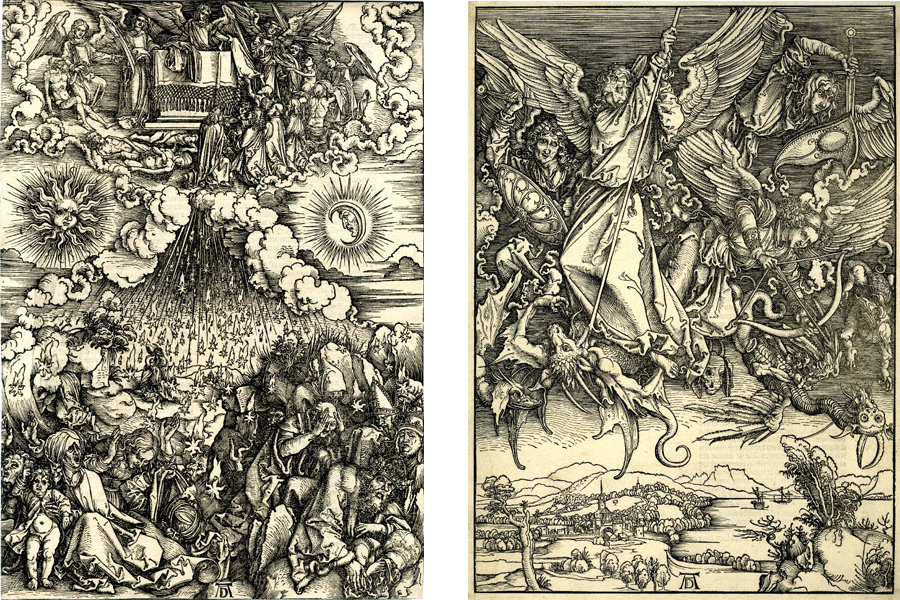
The Apocalyptic Vision of Albrecht Dürer
Apocalypse is a serial of fifteen woodcuts that feature scenes from the Book of Revelation. These memorable works by Albrecht Dürer published in 1498 were probably cut on pear wood blocks and quickly afterward release they became pop across Europe.
Dürer started working on the serial during his get-go trip to Italy between 1494 and 1495. The set was published a few years subsequently, in Latin and High german, in Nuremberg in 1498, at the height of the European frenzy regarding the end of the world which was to happen in 1500. The layout of this series with the illustrations on the recto and the text on the verso reflect the supremacy of the illustrations over the text.
The 2d edition was made in a volume form effectually 1511. The print press, every bit the latest invention of its time, enabled the distribution of the volume to the masses which welcomed its subject thing, and found it relevant in regards to the prophecy of the end times.
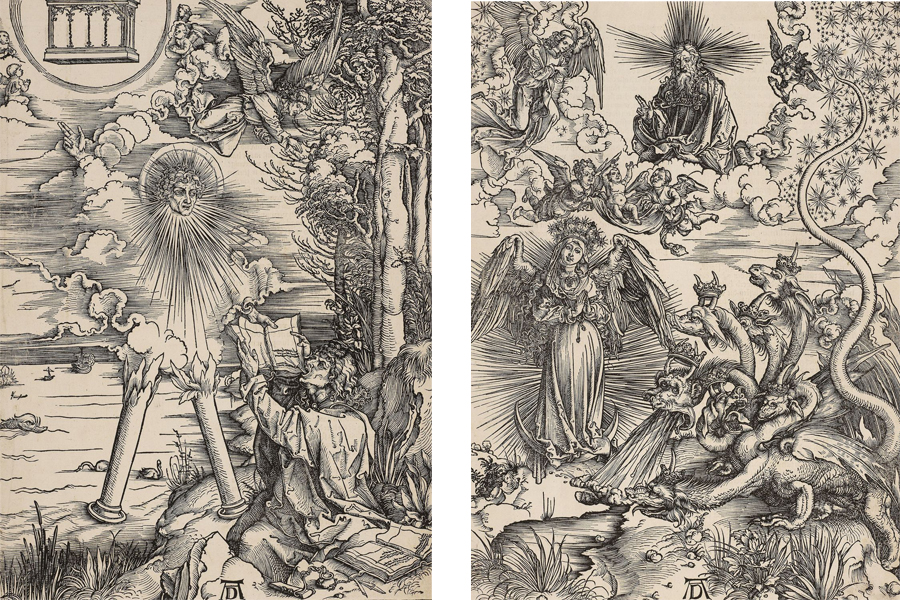
The 4 Horsemen of the Apocalypse
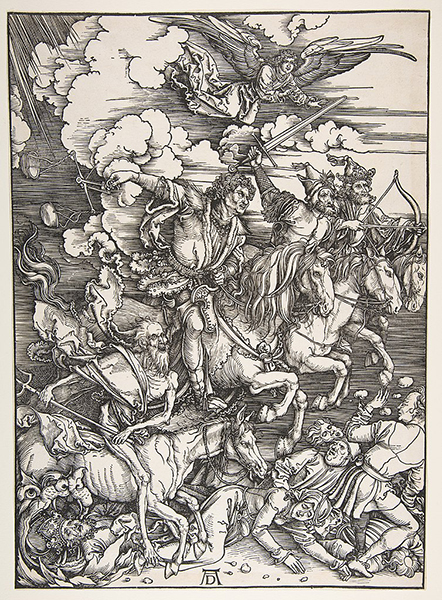
The Four Horsemen is the third and near famous Apocalypse woodcut based on the last book of the New Attestation of the Bible, the Book of Revelation past John of Patmos. At the center of this item chapter is the scene of a book/coil in God's mitt that is sealed with seven seals. The first four of the seven seals are opened by the Lamb of God/King of beasts of Judah which summons four entities that ride white, ruddy, black, and stake horses.
The four riders are symbolizing Conquest or Pestilence, War, Famine, and Death. The apocalyptic vision nowadays in Christianity is that the 4 Horsemen bring the divine apocalypse upon the world announcing the Final Judgment. The number of horsemen is important since iv is the number affiliated with the creation of the earth in the Book of Revelation. The scene also includes a depiction of a wide-jawed creature swallowing a man for which the Apocalypse seems even more rough and powerful than on the other Dürer compositions.
With unprecedented vigor and strength, the artist transformed what was a relatively non-threatening image in previously illustrated examples of these Biblical scenes into an expressive and rather frightening woodcut. Dürer's The Four Horsemenis based on parallel lines betwixt the figures, bones middle tone, volume, and strong diagonal motion; the silhouettes overlap the powerful forms of the horses and riders from left to correct.
The Symbolic of Dürer'due south Woodcuts in Uncertain Times
The Apocalypse series brought Dürer enormous fame and wealth since they captured the zeitgeist of that fourth dimension. Although the European social and political landscape surely changed since these woodcuts were outset published, their outstanding adroitness, the extraordinary interpretation of the Biblical scene and the hit visual vocabulary fabricated them timeless. The series somehow embodied not but the prophetic vision of one of the leading artists of the Northern Renaissance, but they also embodied the artist'due south novel approach to storytelling and the use of print.
In the gimmicky moment, we tin adore Dürer's skillfulness and mod arroyo; however, the Apocalypse seems more than alarming with the current situation on a global scale with the coronavirus. This epitome is to be observed non as the residuum of any prophecies of doomsday that belong to some other time, but rather equally a symbol of the near danger of the apocalypse entirely acquired past the humans who forgot that the planet Earth is non just reserved for them.


Using the prism of Dürer'due south woodcut, The Four Horsemen of the Apocalypse, Andrew Cunningham and Ole Grell offer a new and heady interpretation of European history in the period 1490 to 1648. Dürer'southward image came to characterize the outlook of almost early modern Europeans, who saw repeated episodes of war, epidemics and famine as indicating the imminent stop of the world. Lavishly illustrated with fascinating gimmicky images, The Four Horsemen of the Apocalypse brings together religious, social, military and medical history, giving readers a unique insight into the early mod globe. Andrew Cunningham is a Welcome Trust Senior Research Fellow in the Department of History and Philosophy of Science in the University of Cambridge.
Featured images: Details of Albrecht Dürer - The Four Horsemen, from The Apocalypse, 1498. Woodcut. Sheet: xv ane/four x eleven 7/sixteen in. (38.8 x 29.1 cm). Image: 15 i/iv 10 xi in. (38.seven x 27.9 cm). Collection Metropolitan Museum of Art.
Source: https://www.widewalls.ch/magazine/albrecht-durer-four-horsemen-of-the-apocalypse
0 Response to "What Kind of Art Is Four Horsemen of the Apocalypse"
Post a Comment